¿Por qué fallan los recubrimientos exteriores? | Sinograce Chemical
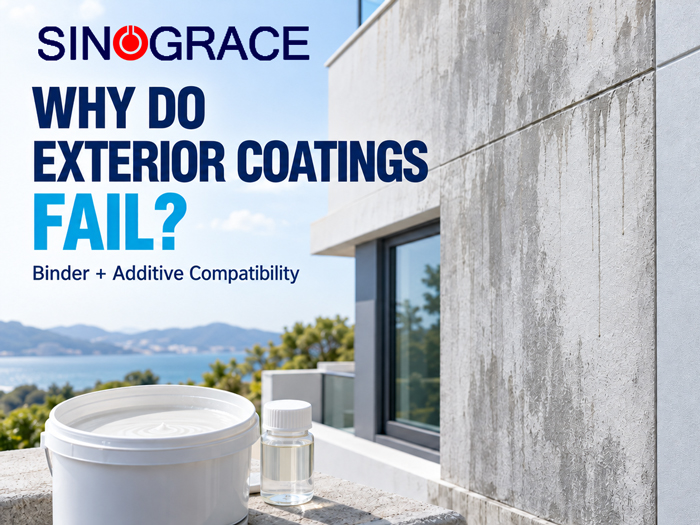
¿Por qué siguen fallando sus recubrimientos exteriores? ¿Son compatibles sus aglutinantes y aditivos? Color desigual en recubrimientos con efecto piedra, gelificación no deseada durante el almacenamiento de pinturas multicolores, marcas de lluvia en acabados elastoméricos y pérdida excesiva de árido durante la aplicación por aspersión: estos problemas pueden afectar tanto a la calidad del recubrimiento como a la eficiencia de la aplicación. Al solucionar problemas, es importante comprobar qué tan bien funciona el aglutinante de emulsión con los aditivos de la formulación. ¿Por qué importa la compatibilidad entre aglutinante y aditivo? El aglutinante de emulsión forma la película de recubrimiento e influye en la adhesión, la resistencia al agua y el rendimiento a la intemperie. Los aditivos se utilizan en menores cantidades, pero desempeñan funciones esenciales en la dispersión de pigmentos, el control de la viscosidad y la gestión de la espuma. Estos ingredientes deben trabajar juntos dentro de la formulación completa para lograr una estabilidad de almacenamiento, un rendimiento de aplicación y unas propiedades de película consistentes. Cuatro problemas comunes y qué comprobar 1. Color irregular o disparejo Compruebe la dispersión de los pigmentos y la compatibilidad entre el aglutinante y los aditivos. En condiciones de frío o humedad, preste especial atención a la temperatura, la humedad y el tiempo de secado. 2. Espesamiento excesivo durante el almacenamiento Una mala interacción entre el aglutinante y el sistema espesante puede hacer que la viscosidad aumente durante el almacenamiento, lo que dificulta la aplicación del revestimiento. El seguimiento de la viscosidad a lo largo del tiempo puede ayudar a identificar cuándo se desarrolla el problema. 3. Marcas de lluvia en la superficie del revestimiento La exposición a la lluvia antes de que la película se haya secado lo suficiente puede extraer y redistribuir los ingredientes solubles en agua, dejando marcas visibles. Se deben evaluar tanto la composición de la formulación como las condiciones de secado. 4. Salpicaduras excesivas y pérdida de agregados Revise conjuntamente el aglutinante, el sistema espesante, la formulación general y los ajustes de pulverización. Las pruebas de aplicación son fundamentales para confirmar si un ajuste mejora el rendimiento. Investigación publicada: Mismo aglutinante, resultados diferentes Un estudio publicado en PCI en 2021 comparó tres formulaciones elaboradas con el mismo aglutinante. Las películas se secaron a 25 °C y con un 50 % de humedad relativa, y luego se evaluaron en cuanto a la lixiviación de tensioactivos. Calificaciones de resistencia a la lixiviación de tensioactivos: de 1 a 5, siendo 5 la mejor. Formulaciones que utilizan el mismo aglutinante Después de 2 horas de secado Después de 4 horas Después de 24 horas Fórmulación 1 1 1 1 Formulación 2 5 5 5 Formulación 3 4 4 5 Fuente: Understanding Surfactant Leaching in Architectural Coatings*, Figura 1...
Lee mas

 español
 English
 français
 русский
 العربية