• La emulsión acrílica se puede utilizar como adhesivo para unir fibras cerámicas.
    La emulsión acrílica se puede utilizar como adhesivo para unir fibras cerámicas.

    2026-01-15

    La emulsión acrílica se puede utilizar como adhesivo o revestimiento como aglutinante para la unión de fibras en el proceso de producción de papel de fibra cerámica. En el proceso de producción de papel de fibra cerámica, emulsión acrílica Se utiliza como aglutinante para la unión de fibras, principalmente por las siguientes razones: Buen rendimiento de unión La emulsión acrílica posee una excelente fuerza de adhesión y puede unir eficazmente las fibras cerámicas para formar una estructura estable. Los grupos polares de su estructura molecular pueden interactuar con la superficie de las fibras cerámicas, potenciando el efecto de adhesión. Resistencia a altas temperaturas El papel de fibra cerámica se utiliza habitualmente en entornos de alta temperatura. Tras una modificación adecuada, la emulsión acrílica presenta una buena resistencia a altas temperaturas, manteniendo su capacidad de adhesión en condiciones de alta temperatura y garantizando la estabilidad estructural del papel de fibra cerámica. Resistencia a la corrosión química La emulsión acrílica tiene buena resistencia a la corrosión química y puede resistir la erosión de sustancias químicas con las que el papel de fibra cerámica puede entrar en contacto durante el uso, lo que extiende la vida útil del papel. Respeto al medio ambiente La emulsión acrílica es una emulsión a base de agua cuyo medio de dispersión es el agua, lo que la hace ecológica y cumple con los requisitos ambientales de la industria moderna. Reduce el uso de disolventes orgánicos y disminuye la contaminación ambiental. Rendimiento de formación de películas La emulsión acrílica tiene buenas propiedades de formación de película y puede formar una película delgada uniforme sobre la superficie de las fibras cerámicas, envolviendo las fibras y mejorando la resistencia y la resistencia al agua del papel. En resumen, emulsión acrílica Se ha convertido en un adhesivo de uso común en la producción de papel de fibra cerámica debido a sus ventajas en rendimiento de unión, resistencia a altas temperaturas, resistencia a la corrosión química, respeto al medio ambiente y rendimiento de formación de película. Sala 1013, Edificio A5, Centro Portuario Financiero, Calle Yangzijiang, Distrito Baohe, Ciudad de Hefei, Provincia de Anhui, China +86 0551 63459511 sales@sinogracechem.com vivisinograce@outlook.com +8615755193346 http://www.sinogracechem.com

    Lee mas
  • Explicación detallada de los procesos y aplicaciones del recubrimiento de tejidos con poliuretano a base de agua
    Explicación detallada de los procesos y aplicaciones del recubrimiento de tejidos con poliuretano a base de agua

    2026-01-09

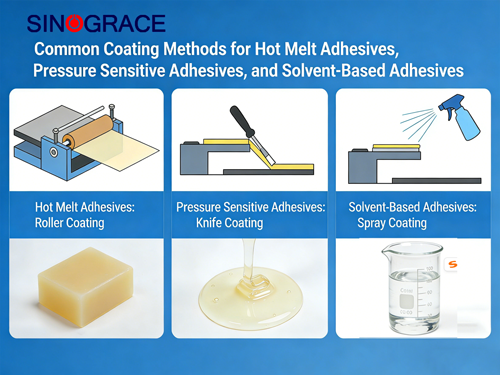
    Recubrimiento textil de poliuretano a base de agua technology is widely used in the textile industry, with different coating methods suitable for different production needs and product functions. The following details five main water-based polyurethane coating methods, including their principles, advantages, and typical application areas. Dip Coating Dip coating is a basic and effective water-based polyurethane coating process. The principle involves directly immersing the fabric in a water-based polyurethane emulsion . Uniform coating is achieved by controlling the immersion time, temperature, and emulsion concentration. This method is simple, easy to operate, and particularly suitable for small-batch production or experimental research. Dip coating is often used for preliminary experiments on functional textiles, such as the development and testing of waterproof and stain-resistant coatings. Pad-Batch Process The pad-batch process is a continuous coating process, mainly including three steps: padding, drying, and heat curing. First, the fabric is immersed in a bath containing water-based polyurethane using rollers to control the liquid content; then it enters the drying stage to remove water and form a preliminary coating; finally, heat curing promotes the cross-linking of polyurethane molecules, enhancing the strength and durability of the coating. This process is highly controllable and suitable for large-scale continuous production, widely used in clothing fabrics, tents, outdoor products, and other fields. Spray Coating Spray coating utilizes atomization technology to evenly spray the water-based polyurethane emulsion onto the fabric surface, and the coating thickness is controlled by airflow. This method is suitable for fabrics with complex shapes or three-dimensional structures, providing uniform coating distribution and good coverage. Spray coating is often used in products requiring high coating uniformity, such as automotive interiors, protective clothing, and home textiles. Knife Over Roll Coating Knife over roll coating uses a doctor blade to evenly remove excess water-based polyurethane emulsion, thereby forming a coating of precise thickness on the fabric surface. This method offers extremely precise control over coating thickness and is suitable for applications requiring high precision, such as medical protective clothing and precision filtration materials in industrial textiles. Composite Modification Method To improve the performance of water-based polyurethane coatings , composite modification techniques are often employed. Blend modification enhances the weather resistance and abrasion resistance of coatings by blending water-based polyurethane with materials such as acrylates and silanes; nanocomposite technology imparts special properties to coatings by adding functional nanomaterials such as nano-titanium dioxide (for UV resistance) or nano-silver (for antibacterial properties); and crosslinking technology further improves...

    Lee mas
  • Dispersión de poliuretano a base de agua
    Dispersión de poliuretano a base de agua

    2026-01-08

    Sinograce Chemical PU series is an anionic aliphatic polyester polyurethane dispersion product, a high-gloss product with a relatively hard feel. It can be used for high-gloss surface treatment of fabrics, leather, synthetic leather, etc. 1. High gloss 2. Excellent yellowing resistance 3. Excellent abrasion resistance Typical properties Appearance:                    Milky white liquid pH: 7.5-9.0 Solid content:                   40±1% Charge:                             Anionic Viscosity (25℃):               100-500cP Tensile strength (MPa):     >25 100% Modulus (MPa):       >20 Elongation (%):               >180 *These properties represent typical results only and should not be considered as specifications.  Refer to the specific Certificate of Analysis (COA) for details. 160kg, 1000 kg Store in a cool, dry place away from light. Storage temperature should be between 5~35℃. Keep the packaging intact. This product has a shelf life of six months from the date of manufacture. Performance evaluation is recommended after six months. This product must be strictly protected from frost.  Skinning may inevitably occur during storage and transportation; therefore, it is recommended to filter the product before use and use it as soon as possible. Anhui Sinograce Chemical Co., Ltd.

    Lee mas
  • Análisis del principio de impermeabilización y ventajas de rendimiento de los agentes de recubrimiento de tejidos de poliuretano a base de agua
    Análisis del principio de impermeabilización y ventajas de rendimiento de los agentes de recubrimiento de tejidos de poliuretano a base de agua

    2025-12-27

    Los agentes de recubrimiento de poliuretano a base de agua para tejidos pueden conferir a las telas una sensación suave y completa, con una textura similar al cuero, y mejorar significativamente la resistencia a las arrugas, la resistencia al encogimiento, la elasticidad y la flexibilidad de las telas recubiertas. Entre ellos, los agentes de recubrimiento de poliuretano a base de agua con propiedades impermeabilizantes son particularmente populares entre los fabricantes y consumidores de telas. Entonces, ¿cómo logran su efecto impermeabilizante en las telas? La clave reside en su capacidad de adherirse firmemente a la superficie del tejido y formar una película continua y densa. Cuanto más densa sea esta película, más difícil será la penetración de las moléculas de agua; al mismo tiempo, cuanto más fuerte sea su adhesión al tejido, más resistente será al lavado y menos propenso a desprenderse. This strong adhesion mainly stems from the polar groups in the water-based polyurethane structure, such as uretha ne bonds, urea bonds, and ionic bonds. These groups interact with the fabric surface through Coulomb forces, van der Waals forces, and hydrogen bonds. The ideal bonding state is when the adhesion between the coating agent and the fabric is greater than the cohesive force of the fabric itself, but less than the cohesive force between the coating agent molecules. The density of the film is directly related to the cohesive energy of the water-based polyurethane molecules: the greater the cohesive energy, the smaller the distance between molecules, and the more compact the resulting film structure. In addition, to achieve better waterproofing effects, the surface tension of the water-based polyurethane film is reduced as much as possible, which increases the contact angle of water droplets on the film, making them less likely to spread out, thus effectively reducing the penetration of water into the coating. Sinograce Chemical produces water-based polyurethane resins for textile applications, including polyurethane waterproof coatings and polyurethane textile resins .  Inquiries are welcome. Room 1013, Building A5, Financial Port Center, Yangzijiang Road, Baohe District, Hefei City, Anhui province, China +86 0551 63459511 sales@sinogracechem.com vivisinograce@outlook.com +8615755193346 http://www.sinogracechem.com

    Lee mas

Derechos de autor © 2015-2026 Anhui Sinograce Chemical Co., Ltd..Todos los derechos reservados.

top