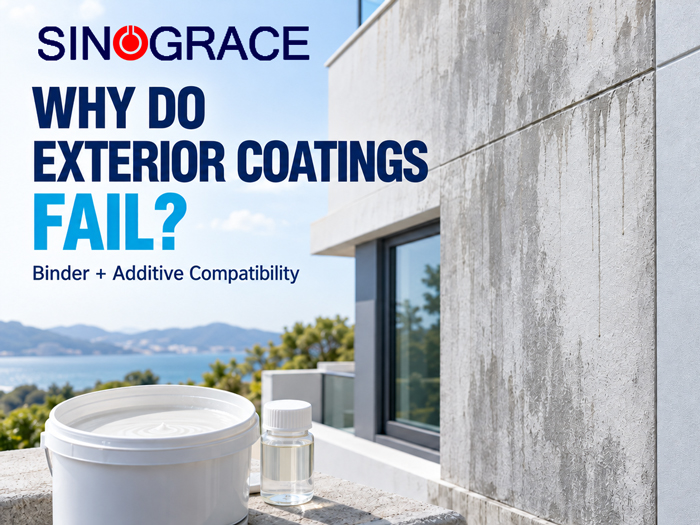
Why Do Your Exterior Coatings Keep Failing? Are Your Binders and Additives Compatible?
Uneven color in stone effect coatings, unwanted gelling during storage of multicolor paints, rain streaks on elastomeric finishes, and excessive aggregate loss during spraying—these problems can affect both coating quality and application efficiency.
When trouble shooting, it is important to check how well the emulsion binder works with the additives in the formulation.
Why Does Binder–Additive Compatibility Matter?
The emulsion binder forms the coating film and influences adhesion, water resistance, and weathering performance. Additives are used in smaller amounts, but play essential roles in pigment dispersion, viscosity control, and foam management.
These ingredients need to work together within the complete formulation to achieve consistent storage stability, application performance, and film properties.
Four Common Problems—and What to Check
1. Patchy or uneven color
Check pigment dispersion and compatibility between the binder and additives. In cool or humid conditions, pay particular attention to temperature, humidity, and drying time.
2. Excessive thickening during storage
Poor interaction between the binder and thickening system can cause viscosity to rise during storage, making the coating difficult to apply. Tracking viscosity over time can help identify when the problem develops.
3. Rain streaks on the coating surface
Rain exposure before the film has dried sufficiently can extract and redistribute water-soluble ingredients, leaving visible streaks. Both formulation composition and drying conditions should be evaluated.
4. Excessive spatter and aggregate loss
Review the binder, thickening system, overall formulation, and spray settings together. Application trials are essential for confirming whether an adjustment improves performance.
Published Research: Same Binder, Different Results
A study published in PCI in 2021 compared three formulations made with the same binder. Films were dried at 25°C and 50% relative humidity, then evaluated for surfactant leaching.
Surfactant leaching resistance ratings: 1–5, with 5 being best.
|
Formulations using the same binder
|
After 2 hours of drying
|
After 4 hours
|
After 24 hours
|
|
Formulation 1
|
1
|
1
|
1
|
|
Formulation 2
|
5
|
5
|
5
|
|
Formulation 3
|
4
|
4
|
5
|
Source: Understanding Surfactant Leaching in Architectural Coatings*, Figure 13, PCI, 2021
Under these test conditions, the coatings showed different resistance to surfactant leaching despite using the same binder, highlighting the importance of evaluating the complete formulation.
Three Steps to Selecting Binders and Additives
Step 1: Start with the application.
Stone effect coatings, multicolor paints, and elastomeric exterior paints have different requirements. Identify the main performance issue before selecting materials.
Step 2: Check compatibility in the formulation.
Keep a reference formulation and change one ingredient or dosage at a time. Compare viscosity, storage stability, and application performance to understand the effect of each adjustment.
Step 3: Verify performance through testing.
Track viscosity before and after storage, film appearance, water resistance, spray losses, and material consumption. Keep the substrate, application method, film thickness, and drying conditions consistent when comparing formulations.
FAQ
Q1: Does using binders and additives from the same brand guarantee compatibility?
Supplier recommendations can help narrow the selection, but compatibility still needs to be confirmed in the actual formulation.
Q2: Will adding more thickener reduce spatter and improve storage stability?
Both thickener chemistry and dosage matter. Adjustments should be evaluated against the required viscosity, flow behavior, and application performance, rather than viscosity alone.
Q3: Is a coating ready for rain once it feels dry?
A dry surface does not necessarily mean the film has fully formed. Rain resistance also depends on the formulation, temperature, humidity, and drying time. Follow the product’s application and drying recommendations.
Q4: What information should I provide when requesting product recommendations?
Share the coating type, current binder and additives, dosages, when the problem appears, and the storage or application conditions. Photos and test results can also help identify the cause.
Sinograce Chemical: Helping Binders and Additives Work Together
Sinograce Chemical supplies waterborne emulsion binders and coating additives, with product selection and formulation support based on customers’ application needs.
Contact Sinograce Chemical to discuss your formulation requirements and application challenges.

 español
 English
 français
 русский
 العربية


